Key takeaways
- Founder-led sites work best when personal trust is part of the sale.
- Firm-led sites work best when process, capacity, and brand reliability matter more than one person's presence.
- The right visual strategy should match why your best clients choose you.
The right visual strategy isn't about personal preference. It's about how your prospects decide to trust you.
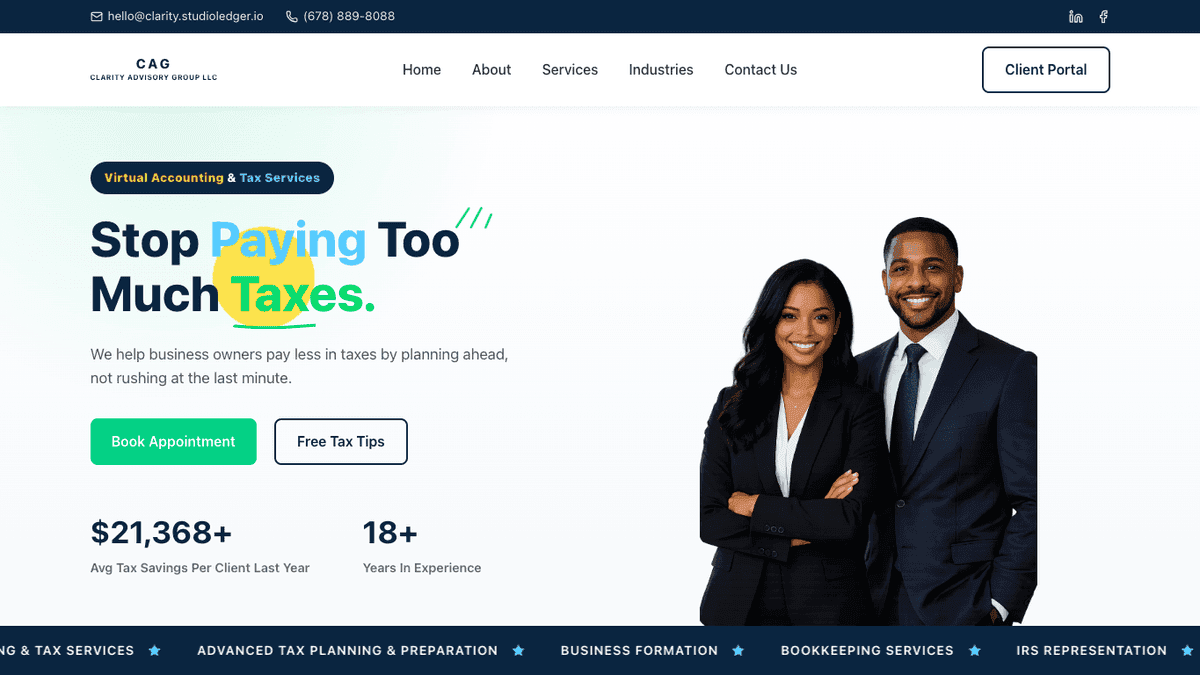
Walk into almost any accounting firm's website and you'll find one of two visual approaches: the firm that leads with a polished brand and professional service copy, or the firm that leads with the person sitting behind the desk.
Both can work. Both can also go wrong in ways that quietly cost you clients. The question isn't which looks better. It's which matches how people actually choose you.
Founder-led websites
A founder-led site puts the principal — the owner, the lead advisor, the person clients will actually talk to — near the center of the brand.
This tends to work best when personal trust is part of the sale. Solo CPAs, boutique tax professionals, fractional CFOs, and relationship-driven local practices often convert better when prospects can see who they're working with before they reach out. The human presence isn't vanity — it's the product.
Done well, a founder-led hero pairs a clear photo with a message that ties identity to service: "Tax planning and bookkeeping for service-business owners who want direct access to an experienced advisor." The photo and the copy point to the same thing.
Firm-led websites
A firm-led site puts the brand, process, and client experience at the front. The practice comes first. The team is present, but not the centerpiece.
This tends to work better for practices with multiple team members, firms targeting business clients, or owners who want the brand to feel established and scalable. It signals capacity. It says: we're an organized operation, not just one person.
A strong firm-led hero leads with positioning and process language: "A modern accounting team for growing businesses that need organized books, tax planning, and clearer monthly decisions."
Where it goes wrong
A solo practitioner using only generic firm imagery can feel less personal than the practice actually is. A larger firm that leans too hard on one founder's photo can look smaller than intended. Neither is fatal — but both create a small friction that stacks up across a page.
The goal is alignment. Your visual strategy should match how your best clients describe why they chose you.
How to decide
Lead with the founder if clients expect direct access to the owner, the founder's credentials are a primary reason people hire the firm, or personal relationships drive most of your referrals and renewals.
Lead with the firm if the practice has a team or is building toward one, clients care more about process and reliability than individual rapport, or the owner wants inquiries tied to the brand rather than their personal presence.
Either direction can support a strong website. The structure — trust signals, clear service fit, process, FAQs, contact clarity — stays the same either way. What changes is where the human element sits in the hierarchy.
Common questions
FAQs about this topic
Is founder-led or firm-led better for an accounting website?
Neither is automatically better. Founder-led works best when personal trust and direct access are central to why clients choose the firm. Firm-led works best when prospects care more about process, reliability, capacity, and an established brand.
When should a CPA use a founder-led website?
A founder-led site is usually strongest for solo CPAs, boutique tax professionals, fractional CFOs, and relationship-driven local practices where the owner's expertise and direct client relationship are part of the value.
When should an accounting firm use a firm-led website?
A firm-led site usually fits practices with multiple team members, firms targeting business clients, or owners who want the brand to feel scalable and not dependent on one person's personal presence.