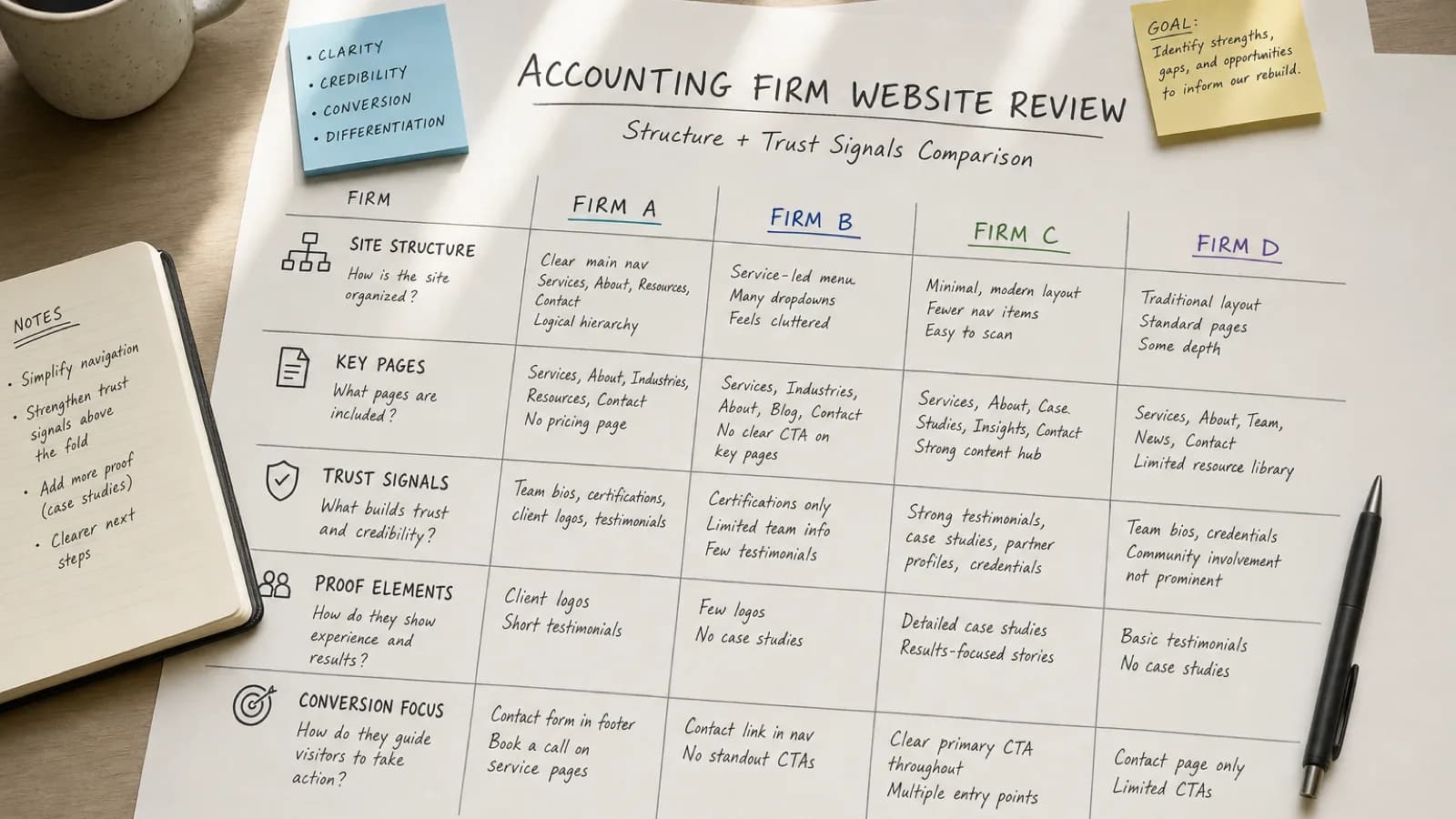
Search "how much does a CPA website cost" and you'll get answers from $500 to $50,000, often on the same page. Both numbers are technically true, which is exactly the problem. Nobody's lying to you — they're just answering a different question than the one you asked.
The real answer has three parts: what you pay to get the site built, what you pay every month after that, and what's actually included at each price point. Skip any one of those and the number you were quoted stops meaning much.
What the market actually charges
These are industry figures, not Studio Ledger numbers — pulled from public pricing breakdowns so you can sanity-check any quote you get. Treat them as ranges, not promises; scope and region move them a lot.
DIY builders (Wix, Squarespace, WordPress.com). The builder itself runs $27–$199 a month. That's the number on the landing page. The number you actually pay shows up once you add a CRM ($97–$497/mo) and any local SEO help ($500–$2,000/mo) — a full stack that lands between roughly $650 and $2,700 a month, according to FlashCrafter's cost breakdown for accountant marketing. Budget 10–20 hours a month of your own time to run it, because nobody else is.
Freelancers and small studios, templated builds. IIH Global's breakdown of accounting website costs puts a basic package (contact form, service pages, mobile-responsive) at $1,000–$3,000, a mid-range build with more customization at $3,000–$8,000, and a high-end custom build with a client portal at $8,000–$15,000 or more. Add $300–$1,200 a year for maintenance on top.
Full-service agencies. Setup fees commonly run $5,000–$16,500, with ongoing retainers of roughly $900–$3,300 a month — a first-year total that can land anywhere from about $15,000 to $56,000, per FlashCrafter's agency comparison. You're paying for strategy, copywriting, and hand-holding, not just a page that loads.
None of these numbers are wrong. They're just answers to different briefs.
What actually moves the price
Once you strip away the marketing language, a handful of things account for almost all the spread between a $1,000 quote and a $15,000 one:
- Custom design versus a template. Templates are cheaper because nobody's drawing anything new.
- Number of pages and how much writing is involved. Copy is labor, and good copy is slow labor.
- A secure client portal or document upload. This is the single biggest jump in scope on most accounting-site quotes.
- SEO scope. "None" costs nothing extra. "Local SEO" and "ongoing content" are recurring line items, not one-time ones.
- Timeline. A rush build costs more than one with a normal runway.
- Who maintains it after launch. If that's not written down, assume it's you.
Three ways firms actually buy a website
DIY builder. Lowest sticker price, highest hidden cost — your own time, plus whatever CRM and SEO tools you bolt on once the plain builder isn't enough on its own.
Freelancer or small studio. The middle path. Often good value, but timelines slip and scope creeps without a fixed structure to hold the project to.
Full agency. The most expensive and the most hands-off for you — and usually the slowest, with builds measured in months rather than weeks.
None of these is wrong. The mistake is paying agency prices for DIY-level scope, or expecting DIY turnaround from an agency process.

What Studio Ledger charges
No range, no "starting at." Setup is $0 to start. $65 a month starts when your site goes live. Pay annually and $650 for the first year is due at go-live, then $650 a year after. The build takes 3–5 days — you're live in under a week, not somewhere in a multi-month queue.
Two things we won't tell you, because they're not true: the site is not yours to keep if you cancel — the monthly or annual fee covers hosting and ongoing care, and canceling takes the site down like any other subscription. And we don't promise rankings. Nobody honest does, at any price, on any package.
Questions worth asking before you sign anything
Whatever you end up choosing, ask the vendor these before you commit:
- What's in the setup fee, and what gets billed separately later?
- What happens to the site if I cancel?
- Is SEO included, and if so, what specifically — and does anyone promise rankings? (If yes, that's the red flag, not the reassurance.)
- Who owns updates after launch — me, or you?
- What's the build timeline, in writing?
Bottom line
A CPA website can reasonably cost anywhere from a couple hundred dollars to five figures, and the number alone tells you almost nothing. What matters is whether the price matches the scope, whether the ongoing cost is clear before you sign, and whether anyone's making promises they can't keep. Ask the five questions above of any vendor — including us — and the right number gets a lot easier to see.
Common questions
FAQs about this topic
How much does a CPA website cost in 2026?
It depends on who builds it. DIY builders run roughly $650–$2,700 a month once you add a CRM and local SEO help. Freelancers and small studios charge $1,000–$15,000+ depending on customization and whether a client portal is included. Full-service agencies run $5,000–$16,500 upfront plus $900–$3,300 a month, for a first-year total that can reach $15,000–$56,000.
What makes a CPA website more or less expensive?
Custom design versus a template, the number of pages and how much copywriting is involved, whether a secure client portal is included, the scope of SEO work, the timeline, and who maintains the site after launch all move the price.
Is SEO included in a CPA website package?
Not by default. "None" costs nothing extra, but local SEO and ongoing content are recurring line items, not one-time ones. Ask any vendor exactly what's included and be wary of anyone promising rankings.
How much does Studio Ledger charge for a CPA website?
Setup is $0 to start. $65 a month starts when your site goes live, or $650 for the first year due at go-live then $650 a year after if paid annually. The build takes 3–5 days.