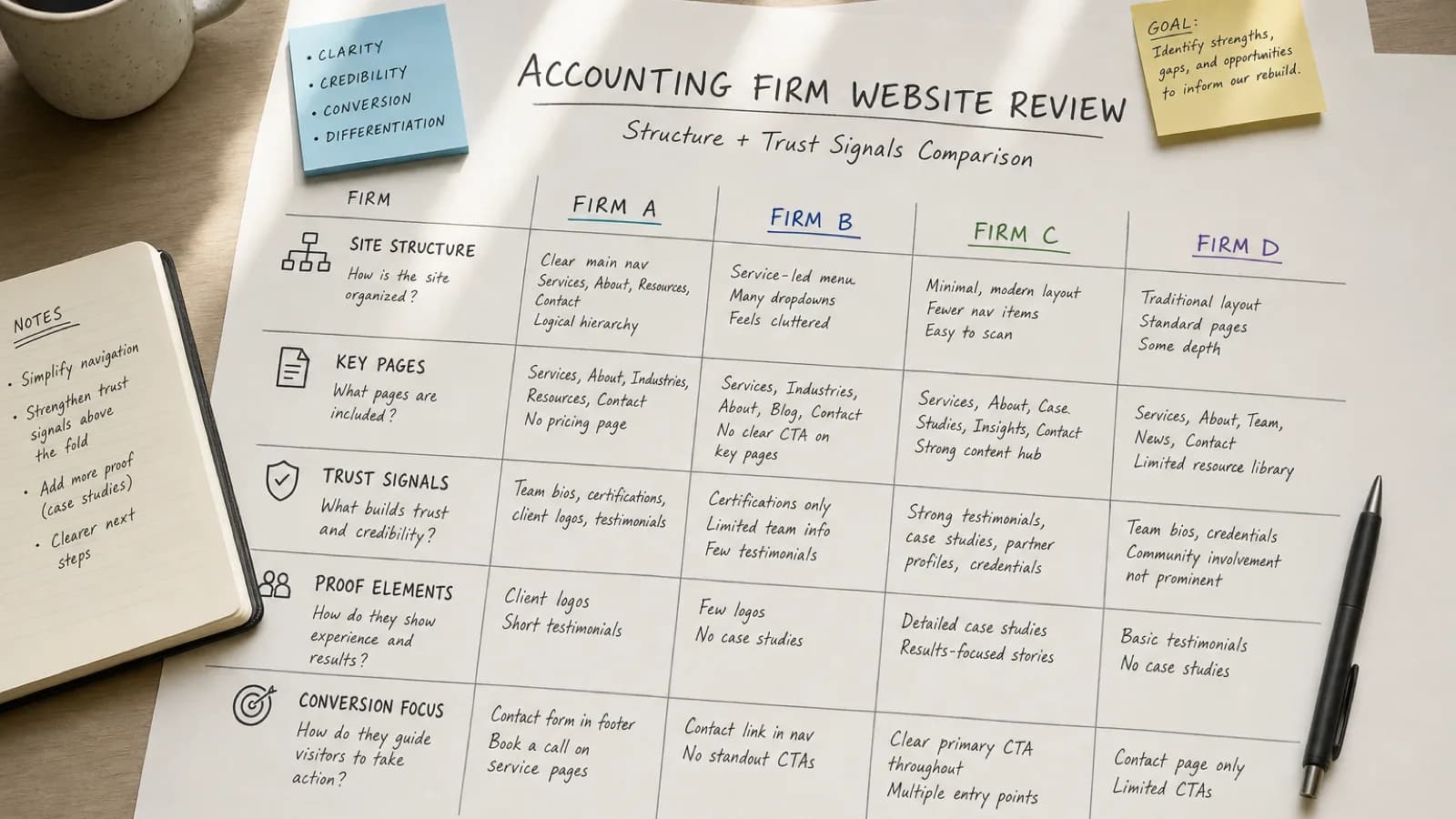
There's a particular kind of prospect that every accounting firm wants more of: a business owner who's serious, organized, willing to pay for good work, and already understands why professional accounting matters. They're not shopping on price. They're looking for a firm they can trust.
These are also the prospects most likely to leave your website without reaching out.
Not because they aren't interested. Because better-fit clients are more discerning. They're not just checking whether you offer the service they need — they're deciding whether working with your firm feels like the right fit. And that decision often gets made in the first thirty seconds on your homepage, long before they've read a word of your bio or looked at your credentials.
An outdated website doesn't just look old. It quietly signals things you probably don't intend to signal.
The Credibility Check You Don't Know Is Happening
Most firms think of their website as somewhere prospects go to find their phone number or confirm their address. In practice, it functions as a pre-screening filter.
Before a serious prospect reaches out to any professional service firm — accounting, legal, consulting — they do a quiet round of research. They look at several options, form impressions of each, and narrow down before committing to any conversation at all. By the time they contact you, they've already made a shortlist.
Your website determines whether you're on it.
The questions prospects are running through aren't complicated:
- Does this firm look like it operates at the level I need?
- Do they work with businesses like mine?
- Can I tell what they actually do and who it's for?
- Does the site feel like it was built by people who pay attention to detail?
That last one matters more than most firms realize. Accounting is a detail business. A website that's cluttered, outdated, or hard to navigate doesn't just look bad — it undermines the core thing you're selling, which is competence and precision.
Why Good Enough Isn't Neutral
There's a tempting logic to leaving an old website alone: we get most of our clients from referrals, so the website doesn't really matter that much.
The problem is that referrals still check the website. Someone who was just told "you should call this CPA firm, they're great" will almost always look you up before they call. The referral creates intent — the website either confirms it or erodes it.
A dated site doesn't just fail to help. It actively introduces doubt at the worst possible moment, which is when someone was already predisposed to trust you.
The same is true for prospects who find you through search or LinkedIn. They arrive with a real question. The website's job is to answer it quickly and make reaching out feel like the obvious next step. If instead it makes them work — unclear navigation, vague service descriptions, a contact form with no context — the moment passes and they move on.
See what a modern accounting firm site actually looks like → Browse designs
What's Actually Breaking Trust
It's rarely one thing. Trust erosion on a website tends to be cumulative — a series of small friction points that together create a feeling the visitor can't quite name but acts on anyway.
Here's where it usually happens:
The headline doesn't say who you're for
"Professional Accounting Services" tells a visitor nothing useful. It doesn't confirm whether you work with small businesses or large ones, individuals or companies, startups or established firms. A prospect who can't immediately see themselves in your positioning has to work harder to figure out if you're relevant — and most won't bother.
The fix isn't clever marketing copy. It's specificity. Name your client type. Name the outcome you provide. "Tax planning and bookkeeping for service-based small businesses" does more work in one line than a paragraph of generic positioning.
Services are listed, not explained
A directory of service names — tax preparation, bookkeeping, payroll, advisory — doesn't help a prospect understand whether any of it applies to them or what they'd actually get. It also makes every firm look identical, because every firm offers the same category names.
What prospects actually want to know is: what does this service look like in practice, who is it for, and what problem does it solve? A few sentences of context per service changes how your offerings read entirely.
There's no visible proof
Credentials matter, but listing them in a footer doesn't make them credible — it just satisfies a checkbox. Real trust signals are placed near the decisions prospects are making: reviews close to the services section, team presence on the homepage, a simple explanation of what your process looks like before someone has to ask.
The psychology here is straightforward. Every time a visitor is about to take a step — read more, reach out, book a call — doubt spikes slightly. Trust signals placed at those moments reduce the friction. Buried in a footer, they don't.
The next step is unclear or intimidating
A blank contact form with a Submit button puts all the burden on the visitor. They have to decide what to say, wonder whether their question is worth asking, and guess how long it'll take to hear back. That's a lot of uncertainty layered onto a moment where you want momentum.
Specific CTAs do the opposite. "Schedule a 20-minute intro call" tells them exactly what will happen. "Request a free tax review" frames the first step as low-commitment and valuable. Even a line like "We typically respond within one business day" reduces the anxiety of not knowing what comes next.
The mobile experience is broken or mediocre
A significant portion of your prospects are going to look at your site on their phone — especially when following up on a referral they just received. If the mobile version is slow to load, hard to navigate, or just a squished version of the desktop layout, it signals the same thing a cluttered office would: this firm doesn't sweat the details.
Studio Ledger sites are built around these trust signals from the start — see what's included →
The Clients You're Losing Are the Ones You Can't See
The insidious thing about website-driven prospect loss is that it's invisible. You don't get a notification that someone visited, decided you didn't look credible, and went with a competitor. The inquiry simply never arrives.
This means firms tend to underestimate the problem. They're measuring conversions on the prospects who do reach out, not accounting for the ones who evaluated them and moved on.
Better-fit clients — the ones with more complex needs, longer relationships, and higher lifetime value — are also the ones most likely to apply this kind of scrutiny. They're more experienced, more selective, and more likely to use your website as a serious credibility filter rather than just a way to find your phone number.
A dated website doesn't push away every prospect equally. It disproportionately pushes away the ones you most want to attract.
What the Numbers Actually Mean
To make this concrete, consider a hypothetical that plays out across the industry constantly.
Two accounting firms. Same size, same services, same number of monthly website visitors — say 300. The only real difference is how their websites are built.
| Firm A (Outdated Site) | Firm B (Modern Site) | |
|---|---|---|
| Monthly visitors | 300 | 300 |
| Conversion rate | 1% | 3% |
| Monthly inquiries | 3 | 9 |
| Qualified inquiries (est. 60%) | ~2 | ~5 |
| New clients per month (est. 50% close) | 1 | 2–3 |
These aren't industry benchmarks or guarantees — they're an illustration of what the math looks like when conversion rate shifts modestly. A 1% to 3% difference sounds small. But compounded over a year, Firm A is closing roughly 12 new clients from their website. Firm B is closing 24 to 36.
With average accounting client relationships lasting years, that gap doesn't stay small.
The point isn't a specific number. It's that conversion rate is a multiplier on everything else — your traffic, your referrals, your ad spend. A weak website doesn't just cost you individual inquiries. It taxes every other effort you make to grow.
If you're running traffic to a site that isn't converting, that gap compounds fast. See Studio Ledger's pricing →
What a Modern Accounting Website Actually Needs to Do
None of this requires an expensive rebrand or a six-month agency project. The standard for a modern accounting firm website isn't high design — it's clarity and credibility.
Specifically, your site needs to:
Make fit obvious immediately. A prospect should know within seconds whether your firm works with clients like them. This is a headline and subheadline problem more than anything else.
Turn service names into service explanations. Each offering should have enough context for a prospect to understand what they'd get and whether they need it.
Show proof near decisions. Reviews, team photos, and process explanations belong close to the moments where prospects are deciding whether to go further — not archived on a separate page.
Give the next step a clear shape. What happens when someone reaches out? How long does it take to hear back? What does onboarding look like? Answering these questions preemptively reduces the hesitation that kills inquiries.
Work well on mobile. Fast, clean, easy to navigate on a phone. This is table stakes now, not a differentiator.
A Note on Design
One thing worth saying plainly: a modern accounting website doesn't need to look like a startup. Firms that try to adopt trendy design aesthetics often end up with something that feels mismatched with the trust and stability their clients are actually looking for.
What "modern" means for an accounting firm is something closer to: clean, current, easy to read, and consistent. It should feel like it was built recently by people who care about quality. That's a lower bar than it sounds, and it's what most of your competitors are missing.
If Your Site Has These Problems, You Already Know It
There's usually not much ambiguity about whether an accounting website is working. If you look at your site and feel mild embarrassment about sending it to a prospect, that feeling is telling you something accurate.
The checklist is short: Does the homepage explain who you work with? Are your services described in terms a prospect can act on? Is there visible proof of credibility near the places where decisions get made? Is the next step clear? Does it work on a phone?
If several of those are no, the site is costing you clients — quietly, invisibly, consistently.
Studio Ledger builds modern websites specifically for accounting firms — designed around these principles from the start, with copy setup and a fast launch process that doesn't require a long custom agency engagement.
Common questions
FAQs about this topic
Why do outdated accounting websites hurt client trust?
Prospects use the website as a credibility filter before they ever reach out. A dated or unclear site introduces doubt at exactly the moment someone was considering whether to contact you — and most won't push through that doubt to send an inquiry.
What should an accounting firm fix first on its website?
Start with the homepage headline and the primary CTA. If a new visitor can't tell within ten seconds who you work with and what to do next, those two things are costing you more than anything else on the page.
Does an accounting firm website need to look cutting-edge to convert?
No. Prospects aren't looking for impressive design — they're looking for signals that your firm is current, organized, and trustworthy. Clean, clear, and professional converts better than trendy.
How much does a weak website actually affect a firm's growth?
It's difficult to measure because the loss is invisible — you never see the prospects who evaluated your site and moved on without inquiring. But the effect is largest on higher-value prospects, who tend to apply more scrutiny before reaching out. Firms with clearer, more credible sites attract fewer poor-fit inquiries and more of the clients they actually want.